
What it actually catches.
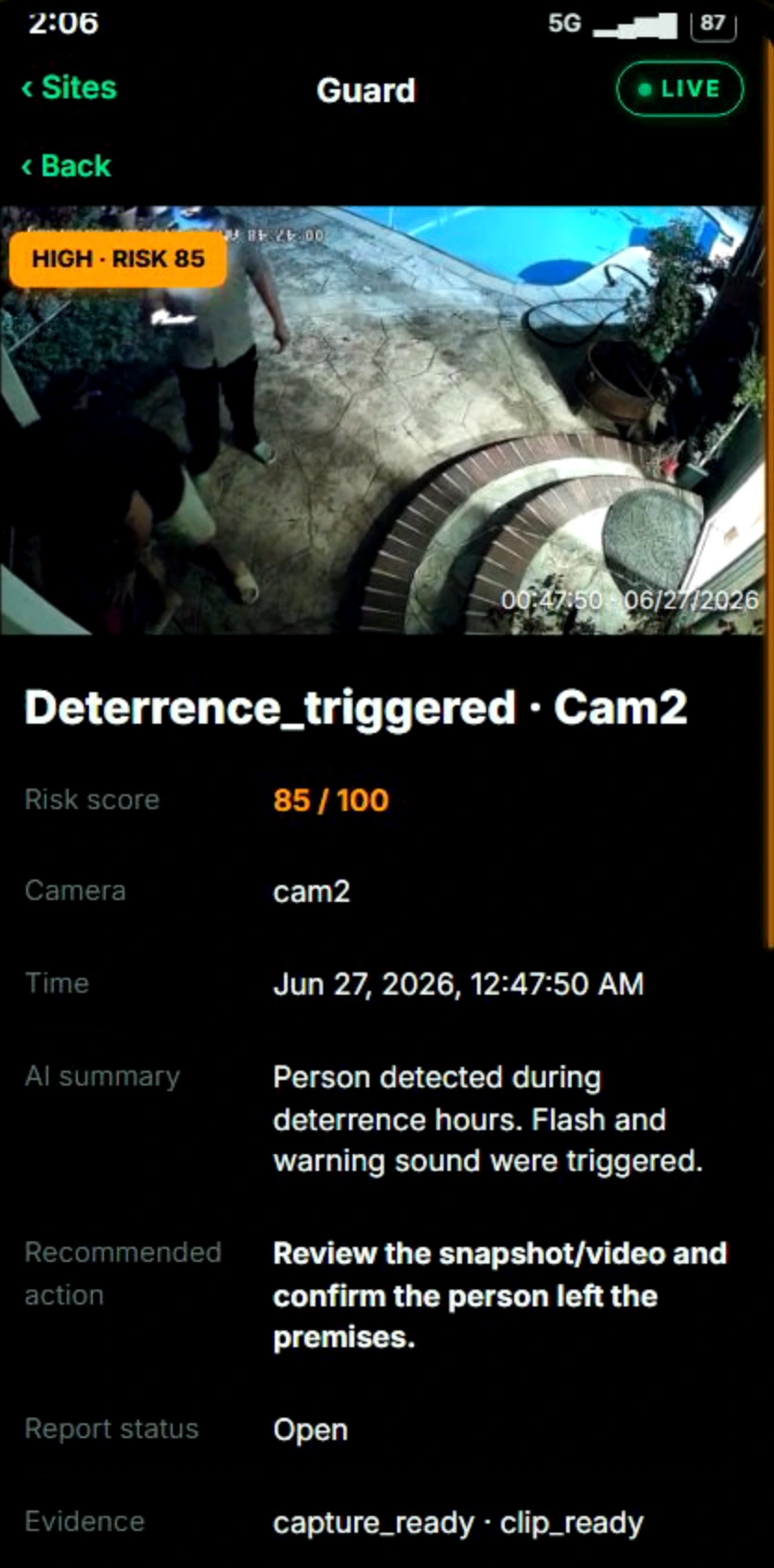
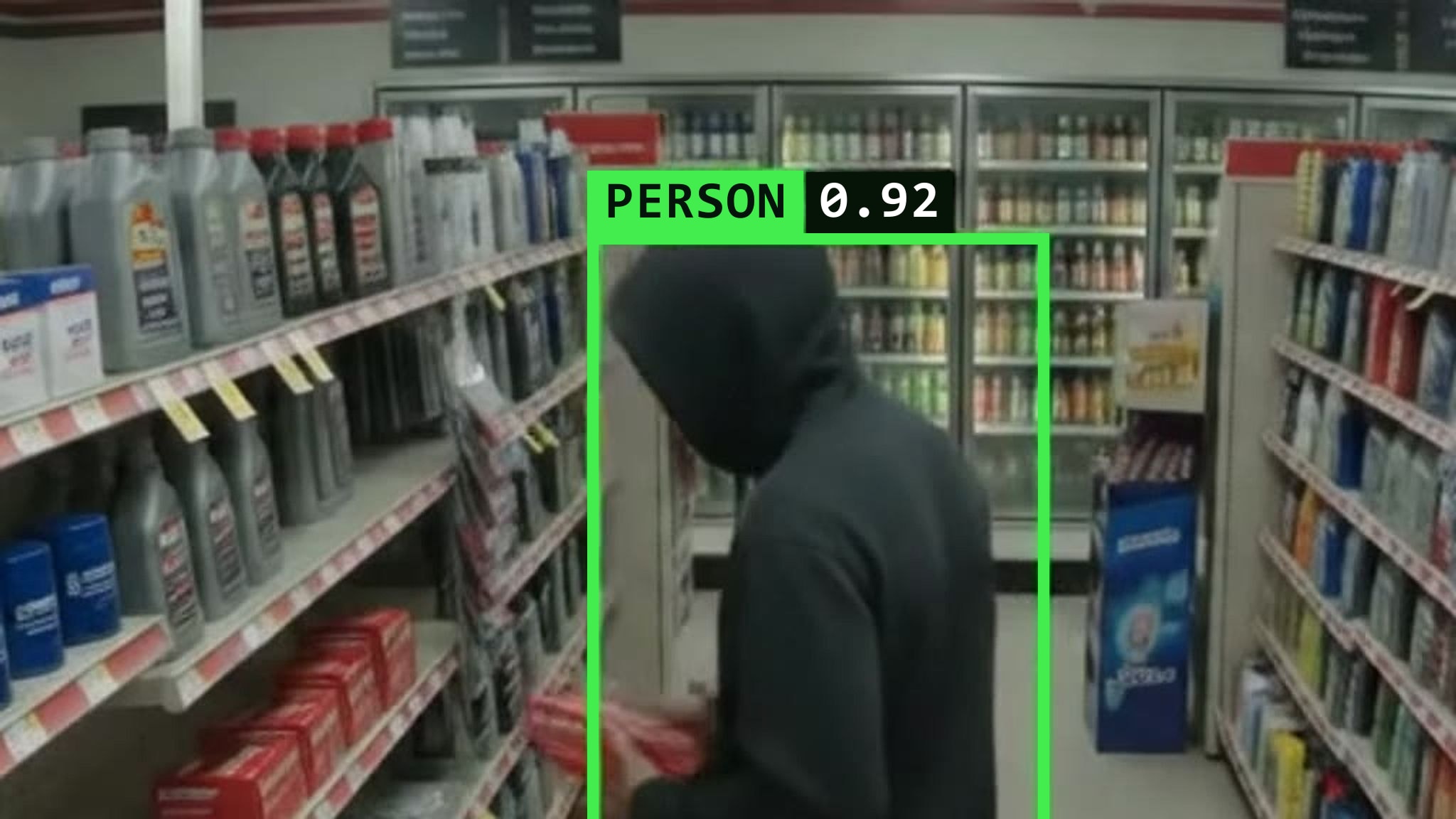
Falls and after-hours presence are real camera captures with live model output. Theft and person-of-interest are staged scenes — the classes run in production, we just are not waiting on a real incident to show you. Each clip says which it is.
Theft & concealment
Waiting for someone to cross the threshold with your stock is waiting too long. Nexovia reads the sequence instead of the exit: a subject holding position at one shelf, an item leaving that shelf, the item not coming back, a hand moving toward a pocket or a jacket.
Concealment fires first at lower confidence as a soft signal. Theft confirms it. By the time the second class trips, the owner's phone already has the clip and the person is still in the aisle.
Fall & medical event
This one is not a bounding box problem. A box around a person tells you nothing about whether they meant to be on the floor. Nexovia runs pose estimation and watches the keypoints: a rapid vertical drop, then a sustained horizontal posture, then an absence of the recovery motion a person makes when they sit down on purpose.
The dwell window is configurable, which is the whole difference between a system people keep switched on and one they mute in week two. Someone crouching to reach a low shelf should never page anybody.
After-hours presence & deterrence
Outside opening hours the logic inverts. During the day a person in the yard needs a second signal before it means anything. At 2am, the person is the signal — no corroboration required, no waiting to see what they do next.
Because the whole chain is on-site, deterrence can fire at the same instant as the alert rather than after a human reads it. Strobe, a spoken announcement over an on-site speaker, or a straight escalation to whoever is on call.
Person of interest & cross-camera tracking
Flag a subject once and the Hive keeps hold of them. Re-identification carries the track across camera boundaries, so somebody who comes in the front, moves through three aisles and leaves by the loading door becomes one continuous timeline instead of six disconnected clips you have to line up by hand afterwards.
This is the feature that turns a two-hour evidence job into a two-minute one, and it is usually the first thing that makes an owner stop treating cameras as an insurance formality.
 Simulated scene
Everything the Hive can be asked to watch for.
Models load per camera, so no site runs classes it does not need. Status below is honest — shipping means it runs on live hardware today and is ready for your site, pilot means it works and is still being calibrated, roadmap means it is built but not yet proven enough for us to put it in front of you as a promise.
| Detection class | What it looks for | Primary sectors | Status |
|---|---|---|---|
| Theft | Item removed from shelf and not returned, followed by movement toward exit | Retail | Shipping |
| Concealment | Object moved toward pocket, bag or clothing inside a monitored zone | Retail | Shipping |
| Fall detection | Pose collapse to horizontal with no recovery motion inside the dwell window | Care · Warehouse | Shipping |
| After-hours presence | Any person classified inside a protected zone outside scheduled hours | All | Shipping |
| Loitering | Subject holding position in a zone beyond a configurable time threshold | Retail · Municipal | Shipping |
| Zone breach | Entry into a drawn polygon — behind the counter, stockroom, plant room | All | Shipping |
| Person of interest | Flagged subject re-identified and tracked across camera boundaries | Retail · Campus | Shipping |
| Person & vehicle | Base classification underpinning every other rule | All | Shipping |
| Operations analytics | People in and out across an entrance line, busy hours by weekday, and — in retail — came in versus bought | All | Pilot |
| Crowd density | Headcount in a zone crossing an upper or lower bound | Retail · Education | Pilot |
| Tailgating | Two or more people through a controlled door on a single authorization | Industrial · Campus | Pilot |
| PPE compliance | Required hi-vis, hard hat or eye protection absent in a designated area | Industrial | Pilot |
| Dock & bay dwell | Vehicle or trailer occupying a bay beyond an expected turnaround window | Logistics | Pilot |
| Weapon detection | Firearm visible in frame, triggering the highest-priority escalation chain | Retail · Education | Roadmap |
| Spill & hazard | Liquid pooling or material spread on a floor surface in a monitored area | Industrial · Retail | Roadmap |
| License plate | Plate read and logged against entry and exit events | Municipal · Logistics | Roadmap |
| Smoke & fire | Visual smoke or flame signature ahead of a conventional detector trip | Industrial · Energy | Roadmap |
Need a class that is not on this list? The model layer is swappable — custom ONNX models compile and load per camera. Tell us what you need to see.
What we will not claim.
Detection accuracy is a function of your camera angle, your lighting and your compression — not just our model. Anyone quoting you a single accuracy percentage across all sites is quoting you a marketing number.
False positives are real
Every vision system produces them. Reflective floors, swinging doors, mannequins, sunlight moving across a wall. The measure of a good deployment is not zero — it is few enough that people keep responding.
Bad angles stay bad
A camera aimed at the ceiling, or compressed until faces are mush, limits what any system can do. We audit your angles before you buy and tell you which ones we would not put a promise on.
The thresholds are yours
Every dwell time, zone boundary and confidence cut-off sits in your console rather than in a config file only we can reach. A system nobody can adjust is a system people mute, so we do not hide the knobs.
Which of these do you actually need?
Most sites run three or four classes, not sixteen. Tell us what keeps going wrong and we will tell you which ones earn their place on your cameras.