
Home / Pilot program

Run it on your own site before anyone else does.

We are taking on a small number of pilot sites. You get a Hive on your cameras, direct access to the two people who build this, and real influence over which detection classes ship next. We get the one thing we cannot buy — a real building, with real traffic, telling us where the model is wrong.

What you get

A Hive sized to your camera count, configured remotely against your actual site. The two of us on the other end of a phone rather than a ticket queue. Detection classes prioritized around what is actually going wrong in your building. And whatever commercial terms we agree for the pilot, held for the pilot period.

Direct line to the builders
What we get

A real site. Every deployment so far has taught us something a test bench could not — a reflective floor that reads as motion, a delivery route that looks like an intrusion, an angle nobody thought to check. That feedback is the entire reason the program exists, and it is worth more to us than the revenue.

Ground truth we cannot fake
Who this suits

A good pilot site, honestly described.

We would rather turn down a site than take one we cannot help. These are the things that make a pilot work, and the things that make it fail.

Cameras that already work

Four or more IP cameras producing RTSP or ONVIF, pointed at things that matter, on a network with a spare switch port. If the angles are poor, no software fixes that — and we will tell you before you commit.

4+ streams · RTSP / ONVIF

A problem you can name

"Stock walks out of aisle three." "Falls in the back room get found twenty minutes late." A specific, recurring incident beats a general wish to be more secure, because it gives us something measurable to aim at.

One concrete failure mode

Someone who will actually reply

The pilot lives or dies on feedback. We need one named person who will tell us when an alert was wrong, ideally within a day. Sites where nobody has time for that get no value from being early.

One engaged contact

Tolerance for rough edges

You are coming in before the polish. Expect false positives in the first weeks, expect to adjust thresholds, expect the occasional feature to arrive mid-pilot. If you need something finished, buy it later at list price and we will not be offended.

Early access is a trade

Not a good fit

Sites needing a compliance certification we do not hold yet. Sites where the only classes that matter are on the roadmap rather than shipping. Anywhere the cameras would need replacing first — that is a different project, and not ours.

We will say so early

Multi-site operators

If you run several locations, we would rather pilot one properly than all of them badly. Pick the site with the worst recurring problem, prove it there, then roll out with numbers behind you.

Start with one location
How a pilot runs

From your camera list to a working site.

Step 1 — Fit check

You send a camera list and one clip

Make, model, count, and footage from the angle you have least faith in. We run it through a Hive and come back with a written read: what we would flag, what we would miss, and which of your angles we would not put a promise on. If the answer is that we cannot help, that is where it ends.

Step 2 — Terms

We agree what the pilot covers

Scope, duration, which detection classes are in, what happens at the end, and the commercial terms. Written down before anything ships, so nobody is guessing later.

Step 3 — Install

The Hive ships, you plug it in

One free port on your switch and a power outlet, roughly ten minutes, no specialist needed. We do not send an engineer. From the moment it dials out we configure it remotely — discovery, zones, schedules, rules and escalation.

Step 4 — Live

Alerts start, thresholds settle

The first weeks are where a site finds its own false-positive personality. Every dwell time, zone and confidence cut-off is in your console to adjust, and we are on the other end when you want a second opinion on a setting.

Step 5 — Review

We look at the numbers together

What fired, what was real, what it caught that would otherwise have been found the next morning. That review decides whether the pilot becomes a normal deployment, and it is also the honest place to conclude it did not work for you.

Commercial terms

What a pilot costs.

Commercial terms — coming soonPilot length, the number of slots and the pricing are being finalized and will be published here. We would rather leave them blank than post a number we have to walk back. Ask us for the current terms and you will get a straight answer the same day.
Duration
Agreed per site before anything ships. Coming soon
PER SITE
Slots
Deliberately limited — we would rather run a handful of sites properly than a queue of them badly. Coming soon
LIMITED
Hardware
A Hive sized to your stream count, shipped to you. You plug it in; there is no on-site engineer to pay for.
SHIPPED
Setup fee
Covers the Hive and its remote configuration. Coming soon
ONE-TIME
Subscription
Console, mobile app, alert delivery, encrypted tunnel, event storage and updates. Coming soon
MONTHLY
Detection classes
Everything marked shipping in the catalogue, plus pilot classes you want to help us prove. Roadmap classes are not promised.
SHIPPING + PILOT
Your footage
Stays yours. Inference runs on the Hive in your building. Anything you send us for a fit check is used only to assess fit and deleted afterwards — we do not train on your footage.
YOURS
At the end
Reviewed together, then either it becomes a normal deployment or it stops. Coming soon
REVIEWED

Pilot or not, the pricing shape is the same two parts — a one-time setup fee and a monthly subscription per site. See how pricing works.

What we ask of you

Four things, none of them onerous.

A pilot is not a free trial with the support switched off. It is a working relationship with a short list of obligations on our side and a short list on yours.

  • One named contact who will tell us when an alert was wrong
  • Permission to look at flagged clips with you when we are diagnosing a false positive
  • A short review at the end, honest about whether it earned its place
  • If it worked, a sentence we can quote — named or anonymous, your call

That last one is the only marketing ask in the program, and it is genuinely optional.

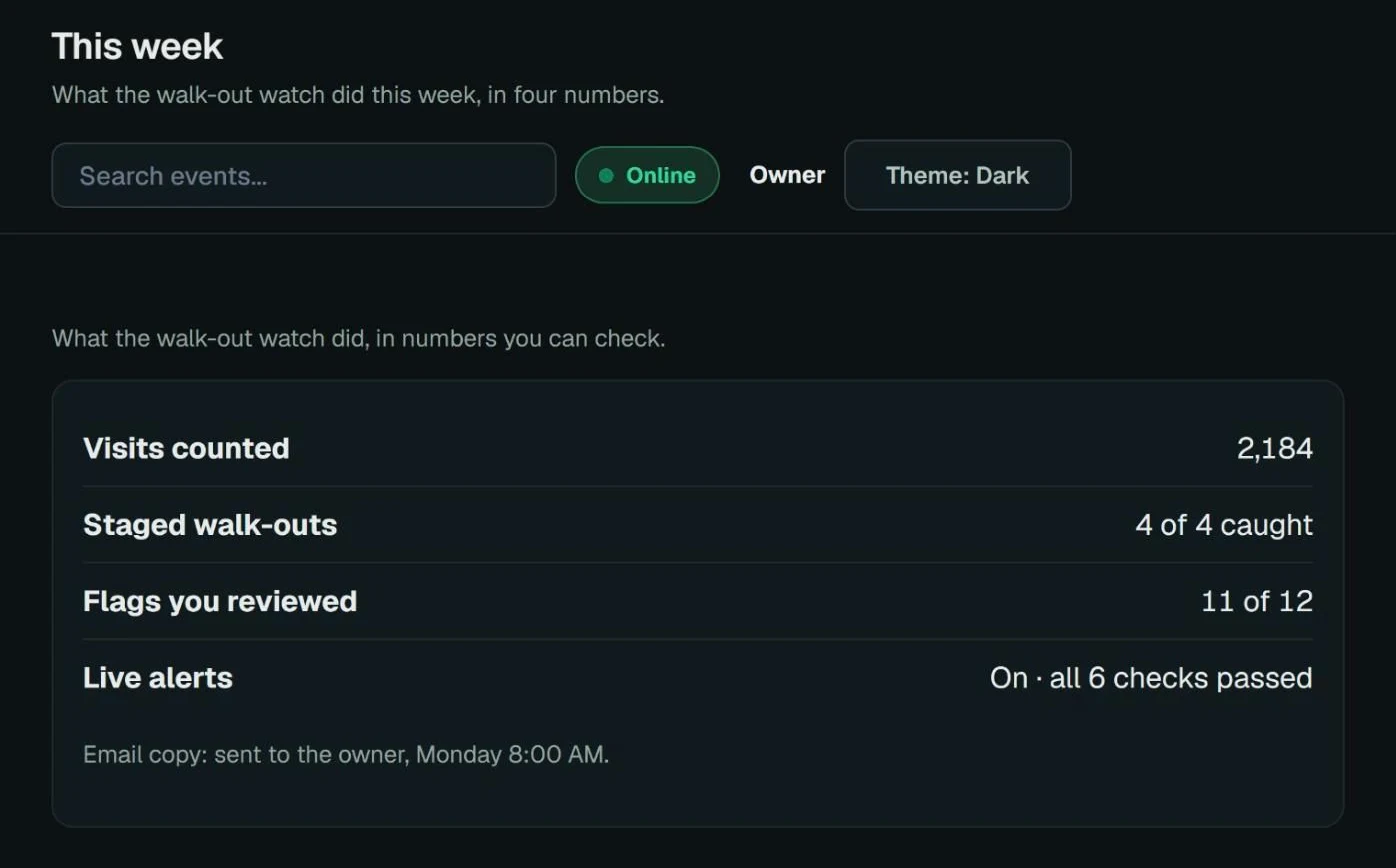
The Nexovia weekly summary, shown with sample data — 2,184 visits counted, 4 of 4 staged walk-outs caught, 11 of 12 flags reviewed, and live alerts on with all six checks passed

Sample data shown.

Send the camera list. We will tell you if it fits.

Make, model and count, plus footage from the angle you trust least. You get a written read on what we would flag and what we would miss — before either of us commits to anything.